Quick answer
Jumper’s knee, also called patellar tendinopathy, is an overuse condition that causes pain around the tendon just below the kneecap. Physiotherapy commonly focuses on load management, progressive strengthening and a gradual return to jumping, running or sport.
Common signs
- Pain below the kneecap during jumping, running or stairs
- Tenderness at the patellar tendon
- Pain that eases during activity but returns afterwards
How physiotherapy may help
A physiotherapist can assess contributing factors, guide tendon-loading exercises, adjust training load and plan a staged return to sport.
Jumper’s Knee: Understanding Patellar Tendinopathy & Recovery
- Pain at the front of the knee.
- Tenderness just below the kneecap.
- Discomfort during jumping, squatting, or climbing stairs.
- Pain that improves after warming up then returns later.
These are classic signs of Jumper’s Knee, medically known as Patellar Tendinopathy.
Despite the name, this condition affects more than just jumpers. It is common in runners, gym-goers, basketball players, footballers, and even individuals who suddenly increase their activity levels. BIt is not just inflammation.
It is a tendon load management problem.
And the solution is rarely “just rest.”
What Is Jumper’s Knee?
Jumper’s Knee refers to irritation and degeneration of the patellar tendon.
The patellar tendon connects:
•The kneecap (patella)
•To the shinbone (tibia)
Its role is critical. It transfers force from the quadriceps muscle to straighten the knee.
Every time you:
•Jump
•Land
•Sprint
•Squat
•Climb stairs
•Stand up from a chair
The patellar tendon absorbs and transmits force. When load exceeds its capacity, micro-damage accumulates.
This is called Patellar Tendinopathy.
Why It’s Not Just “Tendonitis”
The term “tendonitis” implies inflammation.
But chronic tendon pain often involves:
•Collagen fibre breakdown
•Tendon thickening
•Reduced elasticity
•Poor fibre alignment
This is degeneration not pure inflammation. That’s why anti-inflammatory medication alone rarely fixes the problem. The tendon needs progressive loading to rebuild capacity.
Who Gets Jumper’s Knee?
Jumper’s Knee commonly affects:
•Volleyball players
•Basketball players
•Footballers
•Track athletes
•Runners
•CrossFit athletes
•Gym enthusiasts
But it also affects:
•Office workers who start intense gym programmes suddenly
•Individuals who increase stair climbing
•People who gain weight quickly
•Anyone increasing training volume too fast
In Singapore, we often see Patellar Tendinopathy in recreational athletes and weekend sports players.
The pattern is familiar:
Low activity → sudden intense training → tendon overload.
What Causes Patellar Tendinopathy?
The primary cause is repetitive overload.
Risk factors include:
•Sudden increase in jumping volume
•Poor landing mechanics
•Weak quadriceps
•Weak glute muscles
•Tight hamstrings
•Limited ankle mobility
•High body weight
•Poor footwear
•Hard training surfaces
•Inadequate recovery
Tendons adapt slowly. Muscles get strong faster than tendons.
When muscle strength increases quickly, tendon strain increases and if the tendon hasn’t adapted yet, irritation develops.
Symptoms of Jumper’s Knee
•Pain just below the kneecap
•Tenderness at the patellar tendon
•Pain during jumping or landing
•Pain during squatting
•Discomfort climbing stairs
•Stiffness after rest
•Reduced jumping performance
•Pain that improves during warm-up then worsens later
A classic feature:
Pain decreases after warming up, then returns post-activity. This is typical of tendinopathy.
The Tendon Load Model
Tendon pain follows a load-response curve:
Too little load → tendon weakens
Too much load → tendon becomes irritated
Optimal progressive load → tendon adapts and strengthens
The goal of physiotherapy is finding that optimal zone.
Why Complete Rest Is Not the Solution
Rest may reduce pain temporarily.
But prolonged rest leads to:
•Decreased tendon capacity
•Reduced muscle strength
•Loss of stiffness properties
•Greater re-injury risk when activity resumes
The tendon needs load but the right type of load.
Intelligent loading is treatment.
Stages of Patellar Tendinopathy
1.Reactive Stage
Early overload response. Tendon thickens slightly.
2.Tendon Disrepair
Collagen structure becomes more disorganised.
3.Degenerative Stage
Significant fibre breakdown and reduced mechanical efficiency.
Early intervention prevents progression.
Physiotherapy Treatment for Jumper’s Knee
At PhysioFriend, we focus on restoring tendon capacity safely.
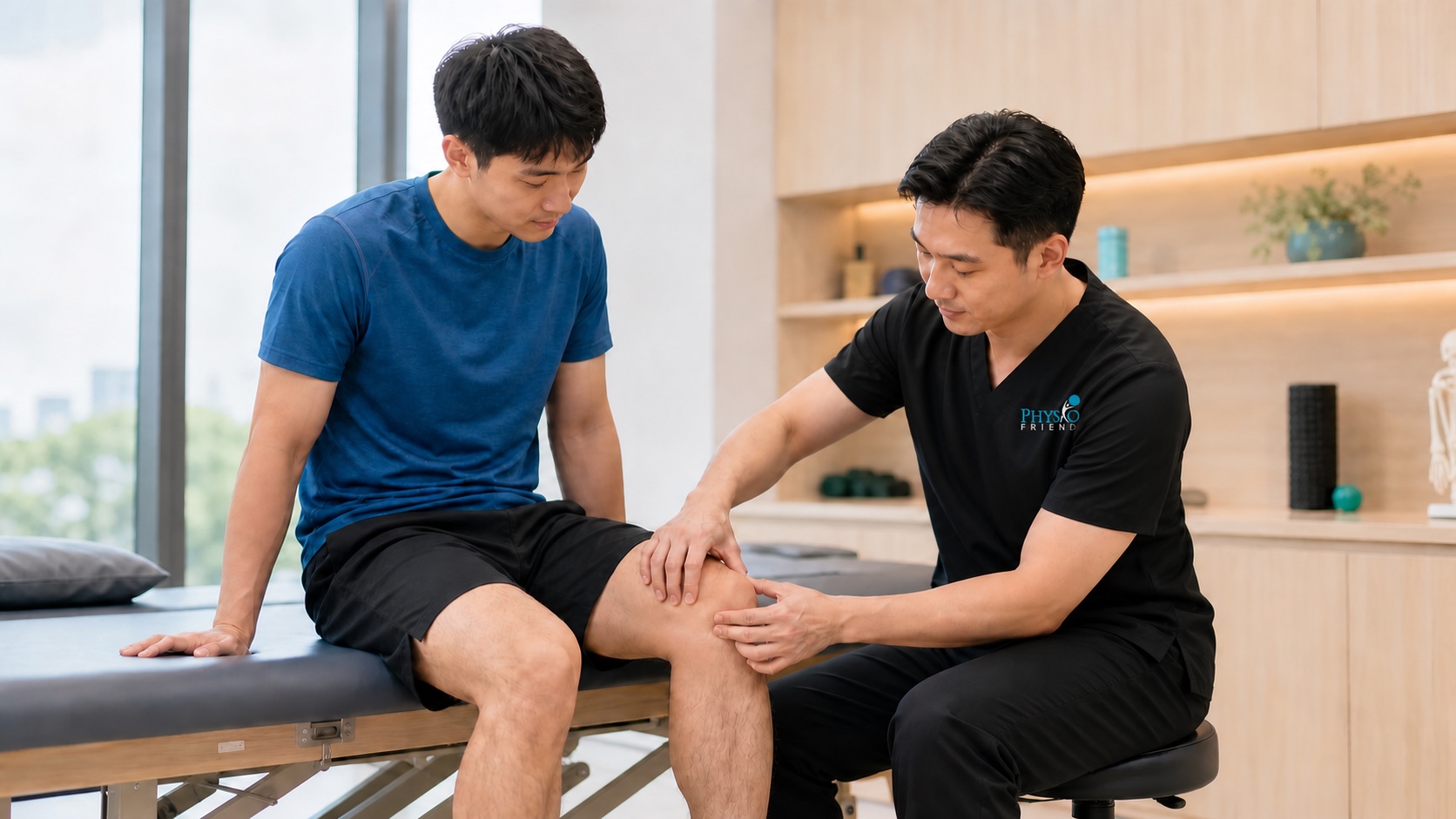
1. Comprehensive Assessment
We evaluate:
•Pain location
•Tendon thickness
•Jump mechanics
•Quadriceps strength
•Glute strength
•Ankle mobility
•Load history
•Training volume
•Foot biomechanics
Understanding what triggered the problem is essential.
2. Load Modification
We temporarily reduce aggravating activities:
•Decrease jump volume
•Avoid deep painful squats
•Modify gym programmes
•Reduce plyometric intensity
We don’t eliminate activity entirely — we adjust it.
3. Isometric Exercises (Pain Reduction Phase)
Isometric holds can reduce tendon pain temporarily.
For example:
•Wall sits
•Isometric knee extensions
This allows continued training without aggravation.
4. Heavy Slow Resistance Training
This is the cornerstone of recovery.
Research supports heavy, controlled strengthening to stimulate tendon adaptation.
Exercises may include:
•Slow squats
•Leg press
•Decline squats
•Weighted knee extensions
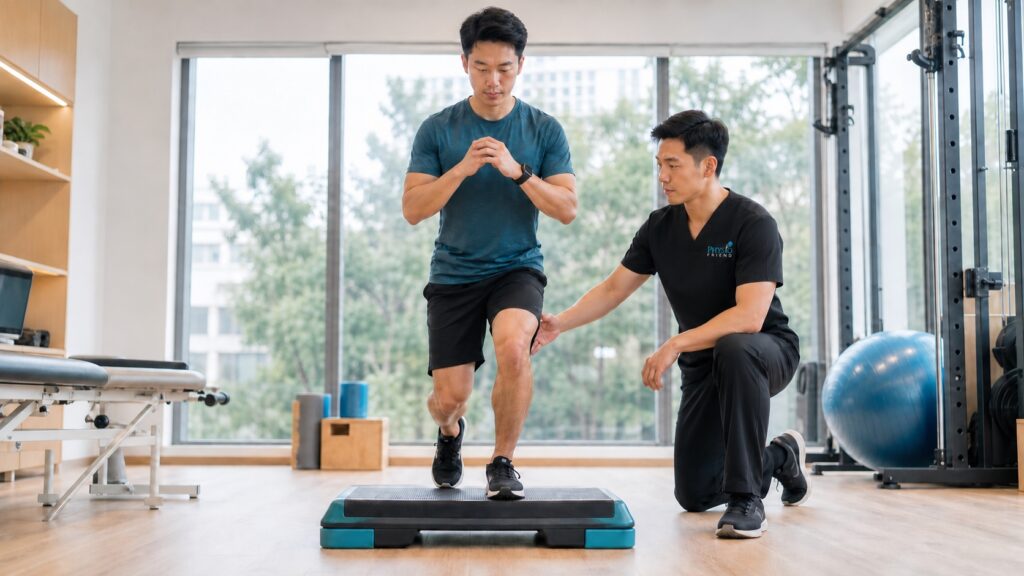
•Step-downs
•Progressive single-leg loading
The key is slow tempo and gradual progression.
5. Hip & Core Strengthening
Weak glute muscles increase knee stress.
Improving hip strength improves force distribution during landing.
6. Landing Mechanics Training
Poor landing technique increases tendon strain.
We retrain:
•Knee alignment
•Shock absorption strategy
•Force distribution
•Jump symmetry
7. Return-to-Sport Progression
Athletes must gradually reintroduce:
•Plyometrics
•Jump volume
•Sprint drills
•Change of direction
Skipping progression leads to recurrence.
How Long Does Recovery Take?
Patellar Tendinopathy is rarely quick.
Mild cases: 6–8 weeks
Moderate cases: 8–12 weeks
Chronic cases: 3–6 months
Tendon remodelling takes time.
Consistency matters more than intensity.
Common Mistakes
•Continuing to train through sharp pain
•Stretching aggressively during painful phase
•Relying only on massage
•Skipping strengthening once pain reduces
•Returning to full jumping too early
•Ignoring hip strength
Pain relief goes not equal full tendon adaptation.
Can It Lead to Tendon Rupture?
Severe degenerative tendons carry higher rupture risk but rupture is rare in managed cases.
Warning signs include:
•Sudden sharp tear sensation
•Immediate inability to straighten knee
•Significant swelling
This requires urgent medical attention.
Structured rehab significantly reduces rupture risk.
Prevention Strategies
Preventing recurrence involves:
•Gradual training progression
•Strength maintenance
•Monitoring jump volume
•Avoiding sudden load spikes
•Adequate recovery time
•Cross-training
•Good footwear
•Addressing landing mechanics
Tendons respond best to predictable load. They dislike surprises.
When Should You See a Physiotherapist?
Seek assessment if:
•Front knee pain persists beyond 2 weeks
•Jumping becomes painful
•Stairs worsen symptoms
•Pain keeps returning
•Performance decreases
•You want safe return-to-sport guidance
Early intervention improves long-term outcomes.
Why Choose PhysioFriend in Singapore?
At PhysioFriend, we:
•Accurately diagnose Patellar Tendinopathy
•Provide evidence based loading programmes
•Customise rehab for athletes and non-athletes
•Address biomechanical contributors
•Guide safe return to sport
•Focus on long-term resilience
We treat tendon capacity not just pain symptoms.
Final Thoughts
Jumper’s Knee, or Patellar Tendinopathy, is a load related tendon condition.
It responds best to:
•Progressive strengthening
•Intelligent activity modification
•Patience and consistency
•Proper return to sport planning
The patellar tendon is designed for power.
With structured rehabilitation, it can regain strength and resilience.
Avoid shortcuts. Tendons reward disciplined progress.
If you’re experiencing persistent front knee pain, early physiotherapy can prevent chronic progression and help you return safely to activity.
Frequently asked questions
Can physiotherapy help jumper’s knee?
Physiotherapy may help by building the tendon’s capacity with progressive exercise, managing aggravating load and correcting movement or strength deficits identified during assessment.
Should I stop running or jumping completely?
Not always. Relative rest and temporary load changes are often more useful than complete inactivity, but the right level depends on your symptoms and assessment.
How long does recovery take?
Recovery varies with symptom duration, training load and tendon capacity. Tendon rehabilitation usually requires consistent, progressive exercise rather than a quick fix.
When should knee pain be assessed?
Seek assessment if pain persists, limits sport or daily activity, follows significant trauma, or is accompanied by marked swelling, locking or an inability to bear weight.