
Quick answer
Plantar heel pain is pain under or around the heel, often felt during the first steps after rest or with prolonged standing and walking. Physiotherapy can address load, calf and foot capacity, footwear factors and a gradual return to activity.
Common signs
- Pain under the heel with the first steps in the morning
- Pain after sitting or after longer periods of standing
- Tenderness around the inner underside of the heel
How physiotherapy may help
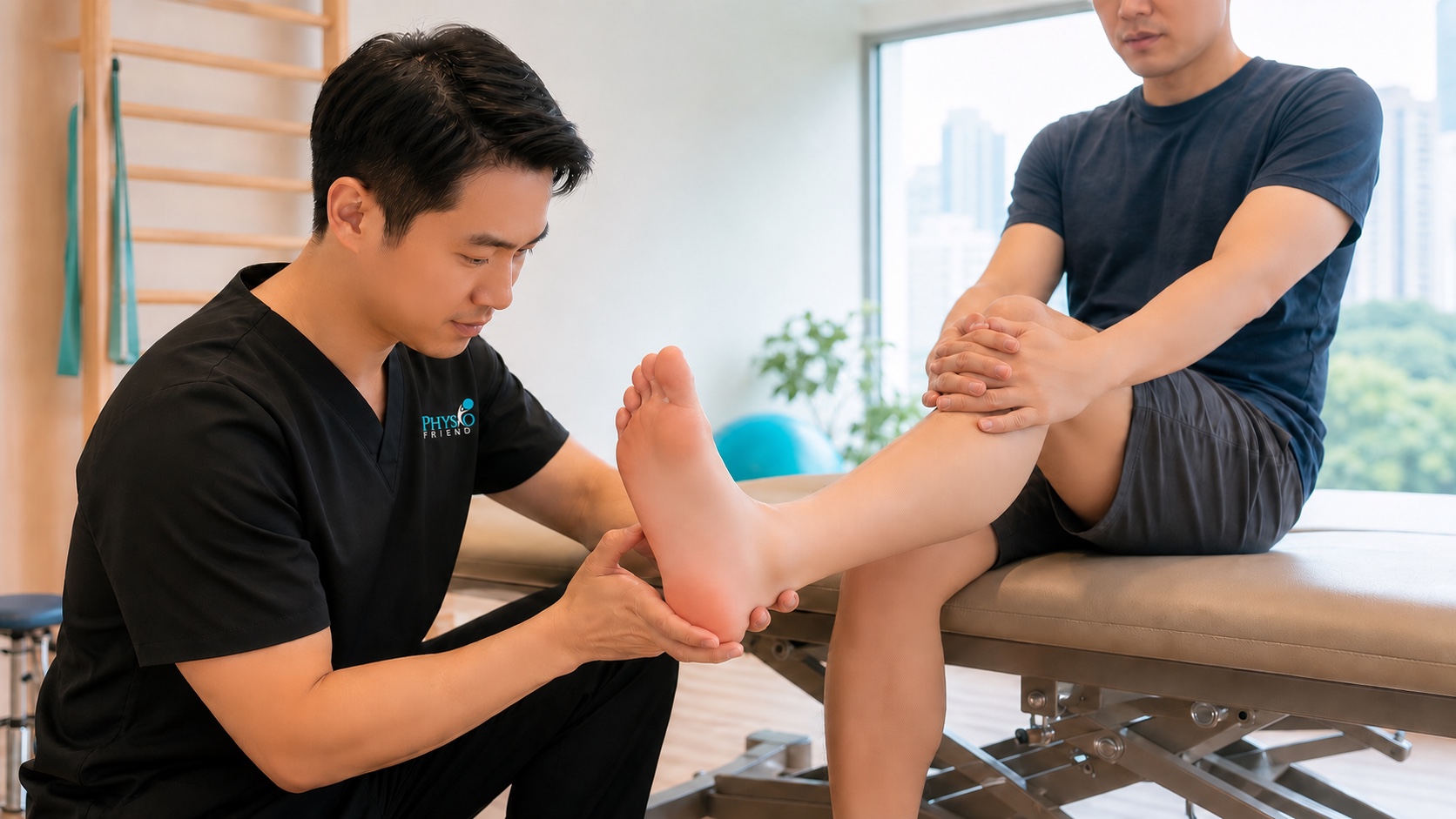
A physiotherapist can help identify aggravating loads, guide calf and foot strengthening, discuss footwear and plan a gradual increase in walking, running or work demands.
Plantar Heel Pain: Understanding Plantar Fasciitis & Calcaneal Fat Pad Irritation
Heel pain can quietly creep into your life. It starts as mild discomfort. Then morning steps become painful. Standing too long feels unbearable. Running becomes impossible. Even walking barefoot at home starts to hurt. This condition is broadly known as Plantar Heel Pain, a term that describes pain at the bottom of the heel.
Two of the most common causes are:
•Plantar Fasciitis
•Calcaneal Fat Pad Irritation
Although many people assume all heel pain is “plantar fasciitis,” that’s not always true. Correct diagnosis determines effective treatment.
Let’s break this down clearly.
What Is Plantar Heel Pain?
Plantar heel pain refers to discomfort located at the underside of the heel, particularly near the calcaneus (heel bone).
The pain may be sharp, aching, or throbbing. It is typically worse:
•In the morning
•After prolonged sitting
•After long periods of standing
•During high-impact activities
•When walking barefoot on hard surfaces
This condition affects runners, office workers, retail staff, teachers, basically anyone who uses their feet (which is all of us).
Plantar Fasciitis: The Most Common Cause
The plantar fascia is a thick band of connective tissue that runs from the heel bone to the toes.
Its function is to:
•Support the arch of the foot
•Absorb shock
•Store and release energy during walking and running
When this tissue becomes overloaded, small microtears develop.
Contrary to popular belief, Plantar Fasciitis is often degenerative rather than inflammatory.
The “-itis” suggests inflammation, but many chronic cases involve tissue degeneration (sometimes called plantar fasciosis).
Symptoms of Plantar Fasciitis
•Sharp pain at the bottom of the heel
•Pain with first steps in the morning
•Pain that improves after moving, then worsens later
•Tenderness near the inner heel
•Increased pain after prolonged standing
The “first step pain” is a classic sign.
Overnight, the fascia tightens slightly. When you stand, it suddenly stretches causing sharp discomfort.
Calcaneal Fat Pad Irritation
Not all heel pain is plantar fascia-related. The heel has a thick cushioning structure called the calcaneal fat pad. This fat pad absorbs impact when you walk. If this cushion becomes irritated, thinned, or bruised, you develop Calcaneal Fat Pad Irritation.
Symptoms of Calcaneal Fat Pad Irritation
•Deep, central heel pain
•Pain directly under the middle of the heel
•Pain worsened by standing on hard surfaces
•Pain when barefoot
•Less “first step” sharpness compared to plantar fasciitis
Fat pad pain is often described as a bruised sensation.
Differentiating between Plantar Fasciitis and Calcaneal Fat Pad Irritation is essential because treatment approaches differ.
What Causes Plantar Heel Pain?
Heel pain is usually due to overload.
Common contributing factors include:
•Prolonged standing
•Sudden increase in activity
•Running on hard surfaces
•Tight calf muscles
•Poor footwear
•Obesity
•Flat feet or high arches
•Weak intrinsic foot muscles
•Poor ankle mobility
Modern lifestyles don’t help.
Hard floors, long work hours, minimal recovery time, the foot absorbs constant stress.
The Role of Calf Tightness
Limited ankle dorsiflexion (ability to bring foot upward) increases tension in the plantar fascia.
Tight calf muscles pull upward on the heel, increasing strain at the fascia attachment.
Improving ankle mobility is often a major part of recovery.
Heel Spurs: Are They the Problem?
Many patients discover “heel spurs” on X-rays.
Heel spurs are small bony growths at the heel.
However:
•Many people have heel spurs without pain.
•Removing a heel spur does not always solve heel pain.
The spur is often a byproduct of chronic tension not the main cause.
Pain usually comes from soft tissue irritation.
Why Rest Alone Doesn’t Fix It
Unlike acute injuries, plantar heel pain is usually a load-management issue.
Completely avoiding activity:
•Weakens the foot
•Reduces tissue tolerance
•Delays recovery
The plantar fascia responds well to controlled loading.
Gradual strengthening is more effective than total rest.
Physiotherapy Treatment for Plantar Heel Pain
At PhysioFriend, treatment focuses on correcting the root mechanical cause.
1. Detailed Assessment
We assess:
•Location of tenderness
•Ankle mobility
•Calf flexibility
•Foot arch mechanics
•Walking pattern
•Muscle strength
•Load tolerance
Correct diagnosis differentiates Plantar Fasciitis from Calcaneal Fat Pad Irritation.
2. Load Management Strategy
We adjust activity levels without complete rest.
Controlled loading stimulates tissue healing.
3. Manual Therapy
Techniques may include:
•Plantar fascia mobilisation
•Calf soft tissue release
•Ankle joint mobilisation
•Foot intrinsic muscle activation
Improving mobility reduces stress concentration.
4. Strengthening Programme
Research supports progressive loading for plantar fascia recovery.
Exercises may include:
•Heel raises (double and single leg)
•Intrinsic foot strengthening
•Calf strengthening
•Tibialis posterior strengthening
•Glute strengthening (yes, hip strength matters)
The foot is part of a chain. Weak hips alter foot mechanics.
5. Taping & Support
Temporary taping can:
•Reduce strain
•Provide arch support
•Improve comfort during early recovery
For Calcaneal Fat Pad Irritation, heel cushioning strategies may be used.
6. Footwear Advice
Supportive footwear can reduce excessive strain.
Hard, flat, unsupportive shoes worsen symptoms.
Barefoot walking on hard tiles often aggravates heel pain.
How Long Does Recovery Take?
Plantar Heel Pain often develops gradually and recovery also requires patience.
Mild cases: 6–8 weeks
Moderate cases: 8–12 weeks
Chronic cases: more than 12 weeks
Consistency is key.
Healing time depends on load tolerance, not just pain levels.
Why Some Cases Become Chronic
Chronic plantar heel pain often results from:
•Ignoring early symptoms
•Continuing high impact activity
•Poor footwear choices
•Incomplete rehabilitation
•Repeated flare ups
•Weak intrinsic foot muscles
Pain reduction does not mean the tissue is fully rehabilitated.
Night Splints: Do They Help?
Night splints keep the ankle slightly dorsiflexed during sleep.
They may help reduce morning stiffness.
However, they are supportive tools not standalone solutions.
Strengthening and load progression remain central to recovery.
When to Seek Physiotherapy
You should seek assessment if:
•Heel pain persists beyond 2–3 weeks
•Morning pain is severe
•Walking becomes painful
•Pain interferes with work
•You’ve tried rest without improvement
•Pain keeps returning
Early intervention reduces chronic risk.
Preventing Recurrence
Once symptoms improve, prevention becomes essential.
Prevention strategies include:
•Regular calf stretching
•Progressive heel raises
•Proper footwear
•Avoiding sudden activity spikes
•Maintaining healthy body weight
•Avoiding prolonged barefoot walking on hard floors
Strong feet are resilient feet.
Why Choose Physio Friend in Singapore?
At Physio Friend, we focus on:
•Accurate differentiation between Plantar Fasciitis and Calcaneal Fat Pad Irritation
•Evidence based loading protocols
•Progressive strengthening
•Functional rehabilitation
•Return to activity planning
•Long-term prevention
We treat not just pain but the mechanical reason behind it.
Final Thoughts
Plantar Heel Pain is common but it should not be ignored.
Whether caused by Plantar Fasciitis or Calcaneal Fat Pad Irritation, proper diagnosis and structured rehabilitation are essential for full recovery. Your feet carry you every day. When they hurt, everything slows down. With the right physiotherapy approach, heel pain can improve significantly and recurrence can be prevented. Healing isn’t passive. It’s progressive, guided, and deliberate.
Frequently asked questions
Is plantar heel pain the same as plantar fasciitis?
The terms are often used interchangeably, but heel pain can have several causes. An assessment helps distinguish plantar fascia-related pain from other conditions.
Should I keep walking with heel pain?
Some walking is often possible, but the amount may need adjusting. A useful plan keeps symptoms within a manageable range and increases load gradually.
Do stretches cure plantar heel pain?
Stretching may help some people, but rehabilitation often also includes progressive calf and foot strengthening, load management and footwear advice.
When should heel pain be assessed?
Arrange assessment if pain persists or affects walking. Seek prompt care after significant injury, with marked swelling, numbness, fever or an inability to bear weight.