Quick answer
Tennis elbow, or lateral elbow tendinopathy, causes pain on the outside of the elbow and may make gripping, lifting or racquet sports uncomfortable. Physiotherapy commonly uses load management and progressive forearm strengthening to restore capacity.
Common signs
- Pain on the outside of the elbow
- Pain with gripping, lifting or using tools
- Tenderness near the bony outer elbow
How physiotherapy may help
A physiotherapist can assess the elbow and related areas, modify aggravating tasks, prescribe progressive wrist and forearm exercise, and guide return to work or sport.
Tennis Elbow: Understanding Lateral Epicondylitis & Recovery
- Pain on the outer side of the elbow.
- Discomfort when gripping objects.
- Pain when lifting a kettle.
- A sharp ache while typing or using a mouse.
These are classic signs of Tennis Elbow, medically referred to as Lateral Epicondylitis. Despite the name, most patients with Tennis Elbow have never played tennis. It is a repetitive strain injury caused by overload of the forearm extensor tendons.
The good news?
It responds very well to structured physiotherapy when managed properly. Let’s break it down clearly.
What Is Tennis Elbow?
Tennis Elbow is a condition involving irritation of the tendons that attach to the outer part of the elbow. Specifically, it affects the tendon of the:
•Extensor carpi radialis brevis (ECRB)
•And other wrist extensor muscles
These tendons attach to a bony prominence called the lateral epicondyle hence the term Lateral Epicondylitis. When these tendons are overloaded repeatedly, microtears develop. Over time, the tissue degenerates rather than simply inflames.
Why It’s Not Just “Inflammation”
The word “epicondylitis” suggests inflammation (“-itis”). However, chronic Tennis Elbow usually involves:
•Collagen fibre breakdown
•Tendon thickening
•Reduced tensile strength
•Disorganised tendon structure
This is more accurately called tendinopathy. That’s why anti-inflammatory medication alone does not solve the problem. The tendon needs structured loading to rebuild capacity.
Who Gets Tennis Elbow?
Tennis Elbow commonly affects:
•Office workers
•IT professionals
•Graphic designers
•Builders
•Mechanics
•Hairdressers
•Gym-goers
•Racquet sport players
•Parents lifting children
•Individuals who use tools repetitively
In Singapore, prolonged computer use and repetitive hand tasks are major contributors. It is often seen between ages 30–55.
What Causes Lateral Epicondylitis?
The primary cause is repetitive overload.
Risk factors include:
•Prolonged mouse use
•Poor workstation setup
•Weak grip strength
•Sudden increase in gym training
•Heavy lifting without conditioning
•Repetitive wrist extension
•Playing racquet sports without proper technique
•Poor shoulder stability
•Overtraining without rest
The wrist extensors are small muscles. When overloaded repeatedly without adequate recovery, tendon irritation develops.
Symptoms of Tennis Elbow
•Pain on the outer elbow
•Tenderness when pressing the lateral epicondyle
•Pain when gripping objects
•Pain when lifting with palm facing down
•Weak grip strength
•Discomfort during typing or mouse use
•Pain during twisting motions (opening jars, turning door handles)
Pain often starts mild and gradually worsens. Ignoring early symptoms increases recovery time.
Why Gripping Hurts
When you grip something:
•Wrist extensor muscles contract to stabilise the wrist.
•Their tendon pulls on the lateral epicondyle.
•If irritated, this pull generates pain.
Even holding a coffee mug can become uncomfortable.
Is It a Nerve Problem?
Sometimes patients worry about nerve compression. However, Tennis Elbow pain is usually localised and mechanical.
Nerve-related pain often includes:
•Numbness
•Tingling
•Radiating discomfort
Proper assessment differentiates these conditions.
Why Rest Alone Is Not Enough
Short-term rest may reduce pain.
But prolonged inactivity leads to:
•Reduced tendon strength
•Decreased load tolerance
•Muscle weakness
•Higher recurrence risk
The tendon needs gradual strengthening.
Load is medicine when applied correctly.
Physiotherapy Treatment for Tennis Elbow
At PhysioFriend, treatment focuses on rebuilding tendon capacity and correcting mechanical contributors.
1. Comprehensive Assessment
We evaluate:
•Pain location
•Grip strength
•Wrist range of motion
•Shoulder stability
•Posture
•Workstation ergonomics
•Load history
•Training habits
Understanding the root cause is essential.
2. Load Modification
We temporarily reduce aggravating activities:
•Adjust gym exercises
•Modify workstation setup
•Reduce repetitive wrist loading
•Adjust sports technique
We don’t eliminate activity — we adjust it intelligently.
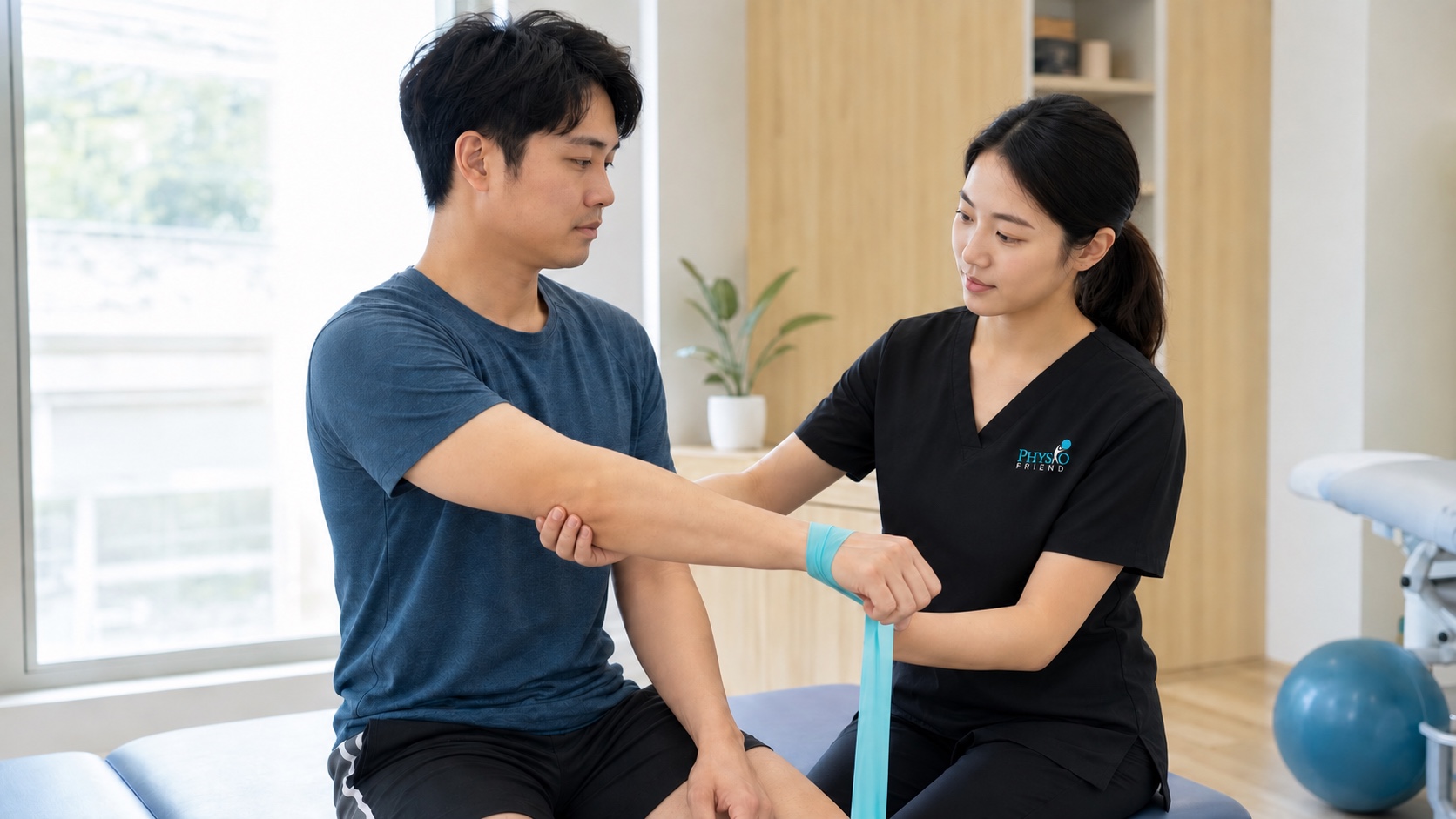
3. Isometric Exercises
Isometric wrist extension exercises can reduce pain sensitivity.
They allow controlled tendon activation without excessive strain.
4. Progressive Strengthening
Heavy slow resistance exercises are key.
Examples include:
•Eccentric wrist extensions
•Controlled dumbbell strengthening
•Grip strengthening
•Forearm loading progression
•Functional loading drills
Slow, controlled loading stimulates tendon adaptation.
5. Shoulder & Scapular Strengthening
Weak shoulder muscles increase strain on the elbow.
Improving shoulder stability reduces distal overload.
The elbow often compensates for shoulder weakness.
6. Manual Therapy
Soft tissue techniques may:
•Reduce muscle tension
•Improve mobility
•Improve circulation
But strengthening remains central.
7. Ergonomic Advice
Small workstation changes can significantly reduce repetitive strain.
We may advise:
•Mouse positioning adjustments
•Wrist support
•Keyboard height modification
•Break scheduling
How Long Does Recovery Take?
Tendon recovery is gradual.
Mild cases: 4–6 weeks
Moderate cases: 6–12 weeks
Chronic cases: 3–6 months
Consistency determines success. Stopping rehab early increases recurrence risk.
Common Mistakes
•Continuing repetitive strain despite pain
•Overusing elbow braces without strengthening
•Relying only on massage
•Stretching aggressively during painful phase
•Ignoring shoulder weakness
•Avoiding all activity
Pain reduction does not equal tendon recovery. Capacity must be rebuilt.
Can Tennis Elbow Become Chronic?
Yes — especially if:
•Symptoms are ignored
•Workstation ergonomics remain poor
•Strengthening is skipped
•Load increases too quickly
Chronic Lateral Epicondylitis can persist for months if unmanaged. Early intervention improves outcomes.
Prevention Strategies
Preventing recurrence includes:
•Gradual workload progression
•Regular strengthening exercises
•Maintaining good posture
•Proper lifting technique
•Adequate rest periods
•Addressing shoulder weakness
•Ergonomic optimisation
Tendons prefer gradual adaptation — not sudden overload.
When Should You See a Physiotherapist?
Seek assessment if:
•Outer elbow pain persists beyond 2 weeks
•Grip strength decreases
•Pain interferes with work
•Gym exercises cause discomfort
•Symptoms keep returning
•Daily tasks become painful
Early physiotherapy shortens recovery time.
Why Choose PhysioFriend in Singapore?
At PhysioFriend, we:
•Accurately diagnose Lateral Epicondylitis
•Provide structured tendon loading programmes
•Address shoulder–elbow interaction
•Offer ergonomic guidance
•Guide safe return to activity
•Focus on long-term resilience
We treat tendon capacity — not just inflammation.
Final Thoughts
Tennis Elbow, or Lateral Epicondylitis, is a load-related tendon condition.
It is highly responsive to:
•Progressive strengthening
•Load management
•Biomechanical correction
•Ergonomic improvement
The outer elbow tendon is strong — but only when conditioned appropriately.
With structured physiotherapy, most patients recover fully and return to work, sport, and daily life without surgery.
The solution is not less movement.
It’s better, smarter movement.
Frequently asked questions
Do you need to play tennis to get tennis elbow?
No. Repetitive gripping, lifting, tools, computer work and other sports can also overload the tendons on the outside of the elbow.
Should I rest tennis elbow completely?
Complete rest is rarely a long-term solution. Temporarily changing aggravating tasks while progressively rebuilding strength is often more useful.
How long does tennis elbow take to improve?
Timeframes vary with symptom duration, work or sport demands and consistency with rehabilitation. Tendon recovery is usually gradual.
When should elbow pain be assessed?
Arrange assessment if pain persists, grip strength falls or daily tasks are limited. Seek prompt care after major trauma or with severe swelling, numbness or rapidly worsening weakness.